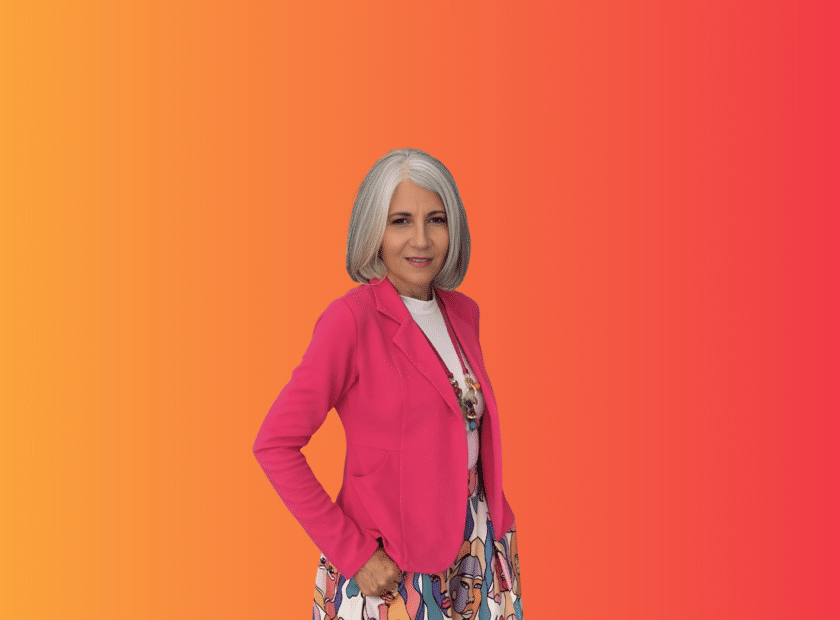
Her life is marked by a mix of personal struggles—such as caring for her mother, who has Alzheimer’s, and her brother, who is in critical condition—and her tireless dedication to the community living with HIV in Puerto Rico. In fact, she was recently honored at the Puerto Rican HIV Conference, “Lazos,” for her 30-year career as an activist.
“The fact that I’m receiving this recognition at this moment is a confirmation and a source of renewed energy for me—it inspires me to keep moving forward and reminds me that many things are possible if we work to make them so,” she reflects.
The issue of aging with HIV has taken on particular significance in her life in recent years, not only because she herself is approaching 60, but also because she is part of a generation that defied expectations. “Living with HIV as we age in these times is truly a privilege. Because for those of us who are nearing 60 or over 60, there was obviously a time when we thought we wouldn’t make it,” reflects Ivette.
“Sometimes it doesn’t matter if you have gray hair or not, if you have more wrinkles or fewer wrinkles… we’re here, we’re alive.” For Ivette, the experience of aging with HIV is fraught with unique challenges, especially because HIV often accelerates the aging process. “The data shows that a person with HIV experiences 7 to 10 years of premature aging—in other words, we age internally faster than a person without HIV.”
One of the major challenges, Ivette explains, is that the medical community is still learning how to manage the long-term health needs of older adults living with HIV. Despite advances in treatment, older adults with HIV often face additional barriers to accessing adequate care. “It’s not just HIV that we’re managing,” says Ivette. “It’s the whole package of aging, with its aches and complications. And it’s not always easy to find doctors who understand this combination of factors.”
Furthermore, the stigma associated with HIV, although it has diminished over time, continues to affect older adults in a unique way. Ivette recalls how rejection was a painful experience she faced from the very beginning of her diagnosis: “I was rejected by one of my relatives to the point that they didn’t want to be touched by me. It was hard, and I could understand that it was a lack of education, but that didn’t take away the pain that rejection caused me.” Over the years, she has seen how education has made a significant difference, but she acknowledges that there is still much to be done. “You can see that over the years… many things have changed, but it hasn’t been eradicated. Despite all the education we’ve provided, because there’s an aspect of the stigma that goes beyond education and has to do with our humanity.”
Ivette has not only been a leader within the community of people living with HIV, but also an educator. “I believe that being an educator is part of activism,” she says. “Because otherwise, it’s useless. An activist without an education can’t get anywhere, because our main tool is precisely education.”
Recently, she has focused her attention on the community of older adults living with HIV, a group that has grown over time as treatments have improved. At 56, Ivette is part of that group and has seen how aging brings with it a series of physical and emotional challenges.
“We do activities, and most of us are 50-plus—over 50—and we start talking about our aches and pains, the aging process, and hormonal changes, especially the women… and then we have to figure out: What’s due to HIV? What’s because I’m getting older?”
Despite personal challenges and daily struggles, Ivette remains committed to her mission. As founder and president of the Permanent Assembly of People Affected by HIV (APPIA), she continues to work to improve access to medications and educate new government leaders on the importance of ongoing treatment. Puerto Rico will have a new government in January 2025. “Every four years we have to start over,” she says with a smile. “But that’s part of the job. If we don’t do it, who will?”
Ivette González is a woman who has found strength in her struggles; she is not only a testament to the power of medical advances, but also to human resilience. “Blessed be aging,” she says, crying and laughing at the same time. “I never thought I’d live to be this old! And despite the gray hair, the wrinkles, and the aches and pains, I’m alive. I’ve watched my children grow up, and now I’m watching my grandchildren grow up. So I’m happy. I’m happy. That brings me so much joy. Despite life’s ups and downs, I’m alive.”
Ivette is part of a generation that not only survived a pandemic that devastated her community but is now navigating the challenges of aging with a chronic condition. “The fact that we’re here, that we’re still fighting, is a reminder of how far we’ve come,” she reflects. “Life hasn’t been easy, but living it has been a gift.”